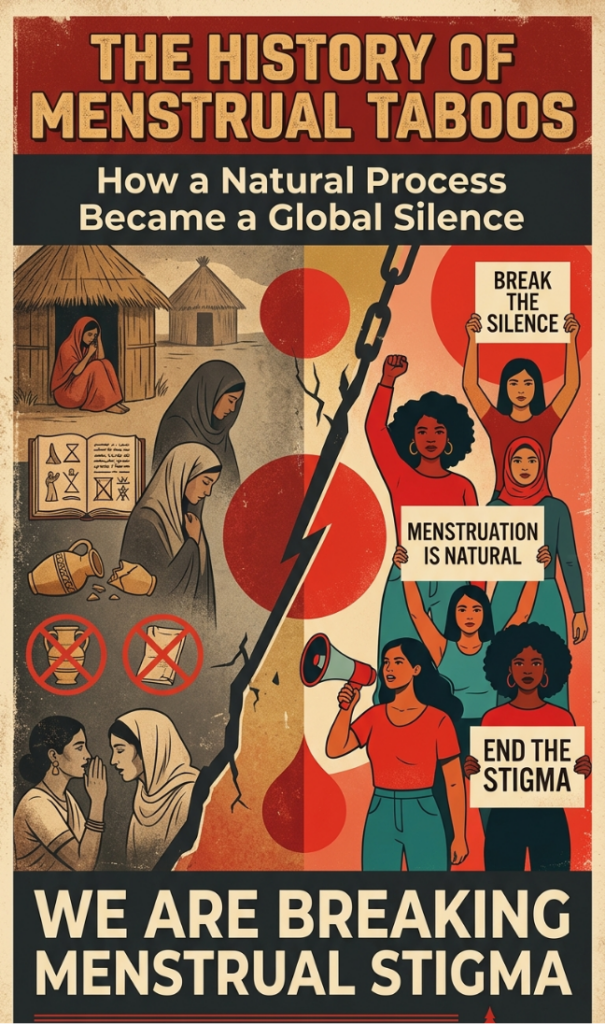
The History of Menstrual Taboos: How a Natural Process Became a Global Silence
- June 3, 2026
- Posted by: Viacame Communication
- Category: Uncategorized
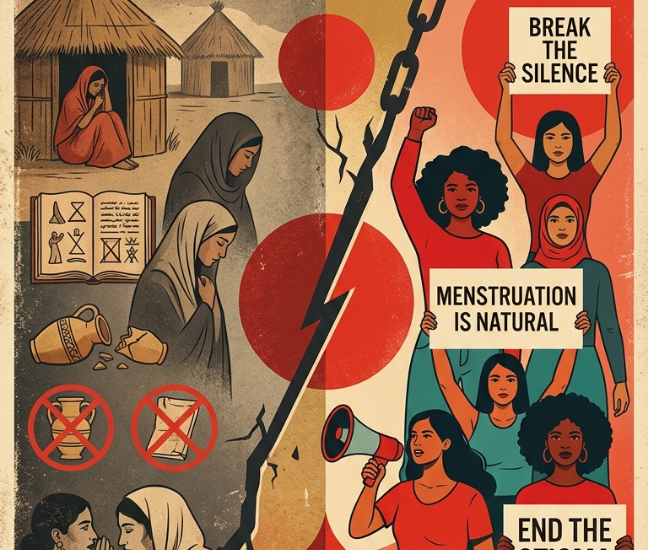
Menstruation is not just biology; it is history, culture, power, and silence woven together over centuries. Why did something so natural become surrounded by fear, shame, and restriction across so many societies? This blog unpacks the deep historical roots of menstrual stigma, from ancient spiritual beliefs to colonial influence, and reveals how a natural process became one of the most misunderstood aspects of the human body.
The History of Menstrual Taboos: How a Natural Process Became a Global Silence
One of the deepest questions in the history of menstruation is why societies came to view menstrual blood as impure, dangerous, or spiritually contaminating despite menstruation being a natural biological process that has existed since the beginning of human life. Every civilization has been shaped through women’s bodies, yet many societies developed systems that feared, controlled, or silenced menstruation. Understanding this contradiction requires looking beyond biology into how ancient societies interpreted blood, spirituality, power, survival, and gender. (Buckley & Gottlieb, 1988; Douglas, 1966).
In ancient societies, blood was never considered an ordinary bodily fluid. It symbolized life, death, sacrifice, spiritual energy, fertility, warfare, ancestry, and divine power. Blood was commonly associated with childbirth, hunting, violence, sacrifice, injury, and death. Because it often appeared in moments of danger or transformation, it carried deep spiritual meaning. Menstrual blood was unique because it appeared regularly without visible injury or death, which created both reverence and fear. Some societies respected it as a sign of fertility and life creation, while others feared what they could not explain.
Before the development of scientific understanding, ancient humans often interpreted unexplained bodily processes through spiritual lenses. Questions about why menstruation occurred, why it was cyclical, and why it was limited to women led to symbolic explanations. Menstruation became associated with spiritual forces, purification, curses, fertility rituals, and supernatural power. As a result, communities created rules and taboos around it as a way of making sense of what was not understood.
It is important to note that in many ancient spiritual systems, impurity did not necessarily mean “dirty” in a modern sense. Instead, impurity was often ritual in nature. Similar concepts existed for childbirth, contact with the dead, sexual activity, and warfare. These were understood as transitions across powerful spiritual states that required cleansing or separation. Menstruation was placed in this category because it involved blood, fertility, and transformation. Over time, however, ritual meanings gradually evolved into social stigma, leading to shame, exclusion, and control.
Another contributing factor was the imbalance of power between men and women in historical societies. While women’s reproductive abilities were visible but not scientifically understood, men often held social and political authority. This created both admiration and anxiety around female reproductive power. Some scholars suggest that menstrual taboos also functioned as a way to regulate women’s bodies, limiting their movement, participation in leadership, access to sacred spaces, and social independence.
Menstruation was also viewed as a liminal state, meaning a transitional condition between categories such as fertility and infertility or purity and impurity. Because of this perceived transitional nature, menstruating women were sometimes isolated, excused from work, or restricted from rituals. In some cases, such separation provided rest and privacy, but over time many of these practices were reinterpreted through patriarchal and colonial systems, contributing further to stigma and exclusion.
A key contradiction in history is that menstruation was often seen as both sacred and dangerous. While women were respected as life-givers and menstruation symbolized fertility, it was also surrounded by restrictions. Many societies believed that powerful forces required boundaries, similar to how fire or water can be both life-giving and dangerous. This dual perception contributed to the development of menstrual taboos.
Across Africa, Asia, and Europe, menstruation developed different cultural meanings, but similar patterns of reverence, restriction, silence, and misunderstanding emerged over time.
Menstruation in African History
Africa never had one uniform belief system about menstruation, as thousands of ethnic groups held diverse spiritual and cultural interpretations. In many African societies, menstruation marked the transition from girlhood to womanhood and was often celebrated through initiation rites, mentorship from older women, and teachings about fertility, sexuality, and adulthood. (Steady, 1981) Menstruation was linked to ancestry, communal survival, and womanhood rather than secrecy alone. Blood in many African spiritual systems was considered powerful and connected to ancestors, protection, healing, and spiritual covenants (Mbiti, 1990). As a result, menstruation was sometimes associated with spiritual energy or vulnerability, leading to temporary cultural restrictions such as avoiding cooking, sexual relations, sacred spaces, or communal activities.
While these practices were often intended as protection, rest, or spiritual balance, over time some became associated with exclusion and stigma, especially following colonial influence. Colonialism introduced Victorian ideas about modesty, purity, and silence around reproductive health, which merged with existing beliefs and intensified menstrual stigma in many communities (McClintock, 1995; Bobel, 2020).
Menstruation in Early Human History and the Origins of Taboos
In prehistoric societies, menstruation was often mysterious due to limited biological understanding. Because menstrual blood appeared without injury, it was frequently interpreted as supernatural or spiritually charged (Delaney et al., 1988. It was sometimes associated with fertility, life, and womanhood, but also with danger, curses, or contamination. These interpretations gradually evolved into cultural rules and taboos passed through generations. (Buckley & Gottlieb, 1988).
One of the strongest roots of menstrual stigma lies in spirituality and religion. Across many ancient civilizations, bodily fluids were linked to ideas of purity and impurity. Menstruating women were sometimes restricted from sacred spaces, isolated temporarily, or viewed as spiritually sensitive (Douglas, 1966).`. However, these beliefs were not always purely negative; in some cultures, menstruation represented feminine power, fertility, and connection to creation. This duality of sacred and dangerous shaped long-standing contradictions in how menstruation was perceived.
Menstruation in Asia
In ancient India, menstruation became closely tied to religious interpretations of purity, leading to restrictions on temple entry, cooking, and ritual participation during menstruation. At the same time, feminine divinity was celebrated through goddesses of creation and fertility, (Garg & Anand, 2015) creating a contradiction between reverence and restriction. In traditional Chinese society, menstruation was linked to bodily balance and life force, yet Confucian norms encouraged silence and modesty around reproductive health (Furth, 1999).. In Japan and parts of East Asia, concepts of ritual impurity (kegare) influenced the exclusion of menstruating women from sacred spaces, reinforcing cultural silence. (Hardacre, 1997).
Menstruation in Europe
In ancient Greece, early medical theories often misinterpreted menstruation, with some philosophers believing it removed harmful substances from the body or that it could affect crops and people (King, 1998).. During medieval Europe, Christian teachings associated menstruation with sin and impurity, reinforcing exclusion from religious participation. By the Victorian era, menstruation became highly hidden and surrounded by silence, embarrassment, and strict social modesty. Girls often entered puberty without education, and these attitudes later spread globally through colonial systems (Delaney et al., 1988; Vostral, 2008)..
Colonialism and the Global Spread of Menstrual Silence
Colonialism played a major role in reshaping menstrual attitudes worldwide. European Victorian ideals of modesty, sexuality, and female behavior were imposed across colonized regions, often replacing or suppressing indigenous knowledge systems (McClintock, 1995). Traditional reproductive education led by women elders was dismissed, and open discussions about menstruation were increasingly restricted. This contributed to long-term silence, stigma, and loss of intergenerational knowledge in many societies. (Bobel, 2020; Vostral, 2008)
Why Menstrual Taboos Persist Today
Despite scientific understanding, menstrual stigma continues due to a combination of cultural traditions, religious beliefs, silence within families, gender inequality, misinformation, lack of education, and social expectations around femininity (Johnston-Robledo & Chrisler, 2013) (UNESCO, 2014). Many girls still grow up hearing that menstruation should be hidden, not discussed, or associated with shame. These messages reinforce fear and disconnection from the body.
Reclaiming Menstruation Through Education and Dialogue
Globally, activists, educators, health workers, and young people are challenging menstrual stigma through education, advocacy, access to menstrual products, and open conversation (UNICEF, 2019). Increasingly, communities are recognizing menstruation as a normal biological process connected to health, fertility, and human life (Bobel, 2020)..
Conclusion
The taboo surrounding menstruation did not originate from one culture or region but developed over thousands of years through a combination of spiritual interpretations, gender systems, medical myths, colonial influence, and social control. Across societies, menstruation was often viewed as both sacred and dangerous, which shaped centuries of contradiction in how women and girls were treated.
Understanding this history shows that menstrual stigma is not natural or fixed. It is socially constructed and therefore can be changed. Breaking the silence around menstruation requires not only education and access to menstrual products, but also a shift in cultural narratives that have shaped attitudes toward women’s bodies for generations. Menstruation has always been part of human history, and the silence surrounding it does not have to continue.
Chat with MORIA Today on WhatsApp +237 6 72 03 35 73 To Know More About Menstruation. This chatbot also dispels myths/ stigma surrounding menstruation.